
When you are looking into choices to replace a missing tooth or a broken bridge, knowing how much time the treatment takes is very important for planning your daily routine. A common question people ask is how long the whole process lasts from the first check-up to the day the final new tooth is put into place.
Usually, a standard dental implant treatment takes anywhere between three and nine months. However, if your jawbone needs extra work to make it stronger before the implant goes in, the whole timeline can stretch to a year or even longer.
It is completely natural to wonder why a single replacement tooth needs several months when other treatments, like crowns or veneers, can be finished in just a few weeks. The reason is down to how an implant fixes into your body. Unlike traditional treatments that sit on top of your gums or attach to the teeth next to them, an implant involves minor surgery to fuse with your jawbone. This natural bone healing cannot be rushed without risking the safety and stability of the final tooth.
Dental Implant Timeline at a Glance
Most people want the short version before the detail. The table below sets out a typical single implant journey. Your own schedule may run shorter or longer depending on the condition of your jawbone.
| Stage | Typical duration | What happens |
|---|---|---|
| Consultation and 3D scan | 1 to 2 weeks | Assessment, CBCT scan and a written treatment plan |
| Extraction, if needed | 0 to 8 weeks | Removal, then healing of the socket where required |
| Bone graft, if needed | 3 to 6 months | Grafted bone matures before an implant can be placed |
| Implant placement | 30 to 60 minutes | The titanium post is placed under local anaesthetic or sedation |
| Soft tissue healing | 1 to 2 weeks | Gums close over and settle |
| Osseointegration | 3 to 6 months | Bone fuses to the surface of the implant |
| Abutment fitting | 1 to 2 weeks | The connector is attached and an impression is taken |
| Final crown | 2 to 3 weeks | The laboratory makes and fits your permanent tooth |
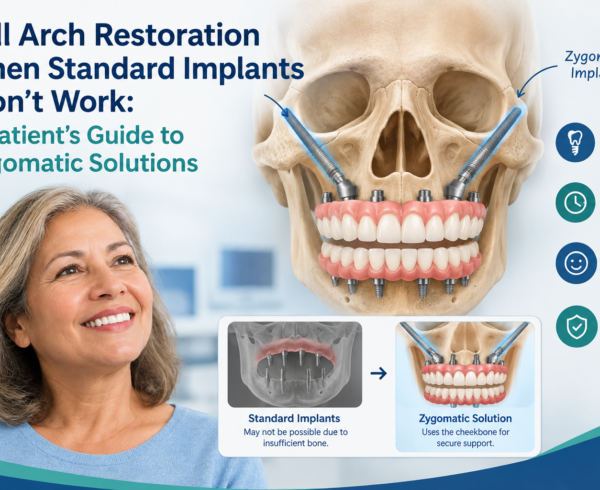
Added together, a straightforward case runs to roughly three to six months. Cases needing a graft usually land between nine and twelve months. If bone loss is the reason you have been told implants are not possible, zygomatic implants can remove the grafting stage from the schedule altogether.
What Determines Your Treatment Timeline?
Every person has a completely different mouth, which means no two dental implant timelines are exactly the same. A few basic health and physical factors will decide how many weeks or months your personal treatment plan will take.
Bone Volume and Quality
The main factor that affects your treatment time is the state of your jawbone. When you lose a natural tooth, the part of the bone that used to hold the root stops getting the daily exercise it needs from chewing. Because of this, the body naturally starts to dissolve that unused bone over time. If a tooth has been missing for a few years, the jawbone might be too thin or shallow to hold a new titanium post safely. In these cases, you will need preparatory treatments to rebuild the bone, which adds a fair amount of extra healing time to your plan.
The Location and Health of the Target Tooth
Where the missing tooth is located also matters a lot. The bone in your lower jaw is naturally harder and denser than the bone in your upper jaw. Because it is so solid, implants placed in the lower jaw usually fuse with the bone a few weeks faster than those placed in the softer bone of the upper jaw. Also, if you need a damaged tooth taken out before the implant can go in, the health of that area will decide whether the post can be placed on the same day or if the empty socket needs to rest and heal first.
The Main Stages of the Process
To get a clear idea of how the parts fit together, it helps to look at how the restoration is built up in steps.
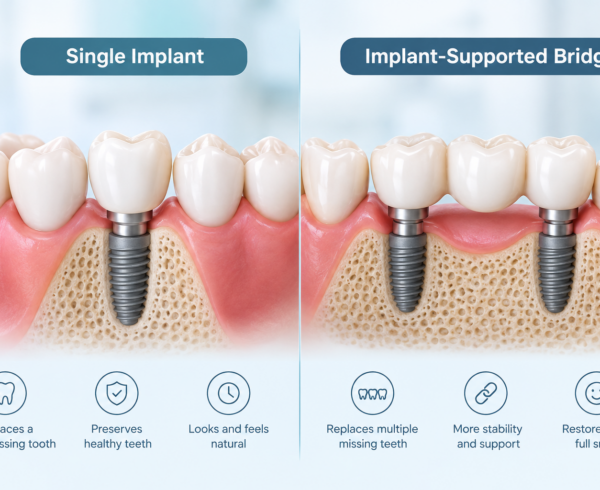
A standard implant replaces the natural setup of your mouth using three distinct pieces. First, the implant post is placed hidden under the gum line to act as the new root. Next, a small connector piece called an abutment is attached to the top of the post. Finally, the visible porcelain crown is fixed onto the connector. Each piece is put in place at different times to give the surrounding bone and gum tissues plenty of time to heal comfortably around the new structure.
Step-by-Step Breakdown of the Treatment
To help you plan your schedule, the treatment can be broken down into clear steps. Each phase must be fully completed before moving on to the next part.
- Weeks 1 to 2 (Initial Check-up and Planning): Your treatment starts with a thorough mouth examination. Your dentist will check your gums, how your teeth meet when you bite, and the state of your remaining teeth. This step involves taking a 3D CBCT scan to look beneath your gums and check the thickness of your jawbone. A clear plan is made during these first appointments to map out the exact position for the new tooth.
- Months 1 to 6 (Preparatory Work): If your scans show that your jawbone is too thin, or if the site is too close to your sinus cavities, you will need early treatment. This might involve a bone graft or a sinus lift to build a firm foundation. If a broken tooth is still in the way, it will be taken out now. Because new bone takes time to harden and turn solid, this step can add three to six months of waiting time before the implant post can be put in.
- Day of the Procedure (Implant Surgery): This is the day the titanium post is placed into the jawbone. The procedure is carried out using a local anaesthetic, so the area is completely numb and you stay comfortable throughout the appointment. The dentist makes a small, neat cut in the gum, prepares a channel in the bone, and gently places the post. The gum is then closed with tiny stitches. The appointment usually takes between one and two hours for a single tooth.
- Months 3 to 6 (Bone Healing and Osseointegration): Once the post is in place, the most important natural healing phase begins, known as osseointegration. Over a few months, your natural bone cells slowly grow directly onto the titanium surface, locking it in like a real tooth root. While this happens deep under your gums, you will not feel anything and can go about your normal daily life. You will just pop back to the clinic for short checks to see how it is settling.
- Weeks 1 to 2 (Attaching the Connector): After the dentist checks that the post is firmly joined to the bone, you will have a short appointment to uncover the top of the implant. The clinician attaches the small connector piece, or abutment, to the post. A temporary cap is placed over it to guide your gums, making sure they heal in a natural shape around the new tooth.
- Weeks 2 to 4 (Making and Fitting the Final Crown): Once your gums have healed snugly around the connector, digital scans or moulds are taken of your mouth. These are sent to a dental laboratory where technicians make your custom porcelain crown. They will carefully match the shape and colour to your other teeth. When the crown is ready, you return for your final visit to have the new tooth permanently fixed into place.
Can Dental Implants Be Done in One Day?
Partly, and the honest answer depends on which part of the treatment you mean. Two quite different things get described as same day implants.
Same day implant placement
Where a tooth has to come out but the surrounding bone is still solid and free from infection, the post can sometimes go straight into the socket at the same visit. That removes the separate healing wait after extraction. Our guide explains when a bone graft can be avoided and who this suits.
Same day teeth
This means leaving with a temporary bridge fitted on the day of surgery rather than living with a gap for months. It is most often possible with implants anchored into the cheekbone, because that bone is dense enough to take the load immediately. Full arch treatments such as All-on-4 and All-on-6 work on the same principle, and both are listed in our fee guide.
What cannot be done in a day
The permanent crown or bridge. Osseointegration still needs its three to six months whichever route you take, so the final restoration always comes later. Anyone promising a finished, permanent result in a single appointment is describing a temporary one.
Comparing Standard and Extended Timelines
Because everyone starts with a different mouth condition, it is helpful to see how a straightforward procedure compares to a case that needs extra preparation.
With a standard timeline, where you have enough natural bone, the process moves along much quicker. The initial check takes a week or two, and you do not need any preparatory bone work before surgery. After the one-day placement appointment, the bone healing phase usually takes around three to four months. The connector fitting takes a week or two, and the final crown is made in about two to three weeks. In total, a standard path takes roughly three to five months from start to finish.
With an extended timeline, where bone grafting is required, the schedule looks quite different. After your initial check, you will need to wait three to six months for the bone graft to heal and harden before any surgery can happen. Once the implant post is finally placed, the bone healing phase can take a bit longer, usually four to six months, because the surrounding bone tissue is still settling. The final steps, which include fitting the connector and making the crown, take the same three to five weeks as a standard case. This brings the total estimated time for an extended path to around nine to twelve months.
Trying to rush through these steps can greatly increase the chance of the implant failing to bond with your bone. Giving your body the exact number of weeks it needs to repair its tissues is the safest way to ensure your new tooth stays firm for a very long time.
Frequently Asked Questions
How long does a single dental implant take from start to finish?
For a straightforward case with healthy bone, expect three to six months from the first consultation to the final crown. Most of that time is spent waiting for bone to fuse to the implant rather than sitting in a dental chair. Cases needing a graft usually run to nine or twelve months.
How long after a bone graft can I have the implant placed?
Grafted bone normally needs three to six months to mature before it can support an implant. Smaller grafts placed at the same time as the implant may add no wait at all. A 3D scan confirms when the site is ready.
How long does osseointegration take?
Between three and six months for most patients. Bone quality, the position of the implant and your general health all affect the pace. This stage cannot safely be rushed, because loading an implant too early is a common cause of failure.
Will I have a gap in my smile while I heal?
Usually not. A temporary crown, bridge or denture can be fitted in most cases so you are not left with a visible space. With cheekbone implants a fixed temporary bridge is often placed on the day of surgery.
Is the process faster if I need several implants?
Often, yes. Multiple implants placed in one surgical visit share the same healing period rather than adding to it, so four implants do not take four times as long as one. Full arch treatment is usually quicker per tooth than single implants done separately.
How long will I need off work?
Most people return to desk work the next day. Two to three days is more realistic after multiple placements or a graft, and physical jobs may need a little longer. Swelling and bruising typically settle within a week.
For a week by week picture of the healing period itself, see our guide to recovery time after a dental implant.
Consult Your Local Dental Practice in Hampshire
Choosing to replace a tooth with a dental implant is a great long-term choice for your physical health, eating habits, and everyday confidence. While the different stages require some patience, the end result is a durable, working tooth replacement that lets you eat, talk, and smile without worrying.
If you live along the south coast and want to know what your personal timeline might look like, talking to a local team can give you a clear answer. For those looking for care near the New Forest borders, booking an initial check-up with a regular Dentist in New Milton can help find out the current state of your jawbone and gums.
At a local clinic like The Ackerman Clinic, the team can use digital 3D scans to check your natural bone thickness and map out a realistic, clear schedule based on how your body heals. Taking the time to look at your options through a personal visit ensures you can start your treatment with confidence and a factual understanding of the steps.
Related reading: Dental Implants.