
Being told that you do not have enough bone for conventional dental implants can leave you unsure about what to do next.
Severe bone loss in the upper jaw can make standard implant treatment difficult. In some cases, patients may be advised to consider dentures or other treatment options. However, conventional implants are not the only type of implant treatment available.
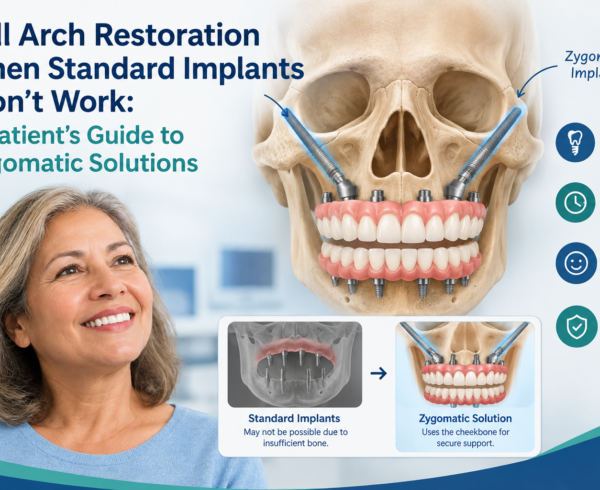
For selected patients with significant bone loss, zygomatic implants may be considered. These implants use the cheekbone for support rather than relying solely on the remaining bone in the upper jaw.
This does not mean that zygomatic implants are suitable for everyone. A detailed assessment is essential, but they may provide another treatment route for some patients who have limited bone.
Why might someone be told that implants are not possible?
Dental implants need suitable bone for support.
When teeth are lost, the bone that previously surrounded their roots can gradually reduce. This can be particularly noticeable when teeth have been missing for many years.
In the upper jaw, the natural anatomy of the maxillary sinuses can also limit the amount of bone available for conventional implant placement.
If there is not enough suitable bone, placing conventional implants may require additional procedures or may not be appropriate.
What happens when there has been significant bone loss?
There is no single approach for every patient.
Depending on the circumstances, your dentist may discuss:
- Bone grafting
- Conventional implants following additional treatment
- Implant-supported dentures
- Fixed implant-supported restorations
- Zygomatic implants
- Conventional removable dentures
The appropriate option depends on your individual anatomy, oral health and treatment goals. You can also explore subperiosteal implants as another approach for patients with limited bone.
What are zygomatic implants?
Zygomatic implants are designed for situations where there is significant bone loss in the upper jaw.
Instead of relying primarily on the remaining upper jawbone, these longer implants engage with the zygomatic bone, which forms part of the cheekbone.
This provides a different foundation for supporting an implant restoration.
Because the implants are placed in a different anatomical area from conventional implants, careful planning is required. If you’d like to see how this compares directly to standard treatment, our guide on zygomatic implants vs traditional implants covers this in more depth.
Could zygomatic implants help if I have been told I have too little bone?
Potentially, but only after an assessment.
The fact that conventional implants are not suitable does not automatically mean that zygomatic implants are appropriate. Your dentist will need to examine your mouth and review three-dimensional imaging to assess the relevant anatomy.
Other factors, including your general health, gum condition, remaining teeth and ability to maintain an implant restoration, will also need to be considered.
What does the treatment involve?
Treatment usually begins with a consultation.
Your dentist will discuss your previous dental treatment and examine your mouth. Imaging is then used to assess the jaw and surrounding structures.
If zygomatic implants are considered appropriate, the proposed treatment will be explained to you, including the stages involved, expected recovery and restoration options.
Depending on the individual case, treatment may involve the removal of remaining teeth, implant placement and fitting of a fixed temporary or final restoration according to the treatment plan. For a broader view of what the process looks like from start to finish, see the full timeline of getting dental implants, from consultation to final crown.
Your dentist will explain the sequence before treatment begins.
Why is three-dimensional imaging important?
The upper jaw is close to several important anatomical structures, including the maxillary sinuses and the eye sockets.
Three-dimensional imaging allows the dental team to assess the available bone and surrounding anatomy in greater detail than a conventional two-dimensional X-ray.
This information helps with treatment planning and implant positioning.
What is a full arch restoration?
A full arch restoration replaces a complete row of missing teeth.
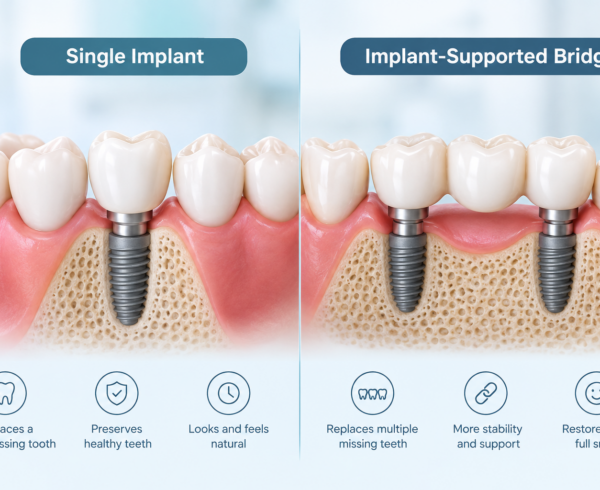
Depending on the situation, implants can be used to support a fixed restoration containing multiple replacement teeth.
For someone who has lost most or all of their upper teeth, this may provide an alternative to a conventional removable denture if the person is suitable for implant treatment.
Zygomatic implants can form part of a full arch treatment plan in appropriately selected patients with substantial upper jaw bone loss.
What is the recovery like?
Recovery varies between patients and depends on the extent of the procedure.
After surgery, it is possible to experience swelling, bruising, discomfort and changes in how the mouth feels temporarily.
You will be given instructions about eating, cleaning your mouth and caring for the surgical sites during the recovery period.
Your dental team will also arrange follow-up appointments to assess healing and the restoration.
What happens after the teeth are fitted?
Looking after an implant-supported restoration is an ongoing responsibility.
Although the restoration is fixed, plaque and food debris can still accumulate around the gumline and beneath accessible areas.
Good daily cleaning is therefore important.
Your dentist or hygienist can recommend suitable brushes and interdental cleaning aids and demonstrate how to use them.
Regular dental reviews are also important so that the condition of the gums, implants and restoration can be assessed. It’s also worth reading about general dental implant risks and complications before deciding on treatment.
Is this treatment suitable for everyone?
No.
Zygomatic implants are intended for particular clinical situations and should not be presented as an option for every patient with missing teeth.
A dentist needs to assess your anatomy, dental health and individual circumstances before deciding whether they may be appropriate.
There may also be alternatives worth considering.
A proper consultation should therefore include discussion of the potential benefits, limitations, risks and alternatives.
When Conventional Implants Are Not an Option
Being told that conventional dental implants are not suitable does not necessarily mean that there are no other treatments to discuss.
Zygomatic implants are one possible approach for carefully selected patients with substantial bone loss in the upper jaw. They require detailed assessment and planning, and alternatives should also be considered.
If you have previously been told that there is not enough bone for conventional implants, it may be worth discussing the full range of options available for your particular circumstances. Cost is often part of that conversation too — see our fee guide for more on pricing and finance options.
Discuss Your Implant Options in New Milton
The Ackerman Clinic can assess your dental health and discuss potential treatment options with you. If you are looking for a Dentist in New Milton to discuss missing teeth and implant treatment, arrange a consultation to find out what may be appropriate for your circumstances.
Frequently asked questions on Zygomatic Implant Treatment Options
Q. What if I have been told I have no bone for dental implants?
Ask your dentist whether you are suitable for any other implant approaches. Depending on your circumstances, this could include bone grafting, different implant-supported treatments or, in selected cases, zygomatic implants.
Q. Are zygomatic implants only for people with no teeth?
No. They may be considered in patients with extensive upper jaw bone loss who require an implant-supported restoration. The condition and position of any remaining teeth will form part of the assessment.
Q. Can zygomatic implants replace a full set of upper teeth?
In suitable cases, zygomatic implants can be used to support a fixed full arch restoration for the upper jaw.
Q. Do zygomatic implants require bone grafting?
One of the purposes of zygomatic implants is to use the zygomatic bone for support when conventional implant bone is limited. Whether additional procedures are needed depends on the individual treatment plan.
Q. Are zygomatic implants permanent?
The implants are intended to provide long-term support, but no dental treatment can be guaranteed to last indefinitely. Ongoing oral hygiene, regular reviews and appropriate maintenance are important.
Q. Can I eat normally with fixed implant-supported teeth?
The aim of a fixed restoration is to allow you to eat and function with replacement teeth. However, there may be an adjustment period after treatment, and your dentist will provide advice about eating during recovery and caring for the finished restoration.
Q. Are there alternatives to zygomatic implants?
Yes. Depending on your circumstances, alternatives may include bone grafting followed by conventional implants, other implant-supported solutions or removable dentures.
Q. How do I find out whether zygomatic implants are suitable for me?
The appropriate starting point is an assessment with a dentist experienced in evaluating complex implant cases. You will usually need a clinical examination and appropriate imaging before a treatment plan can be considered.